



IT Outsourcing Without the Clutter: Why Reducing Your Tech Stack Matters

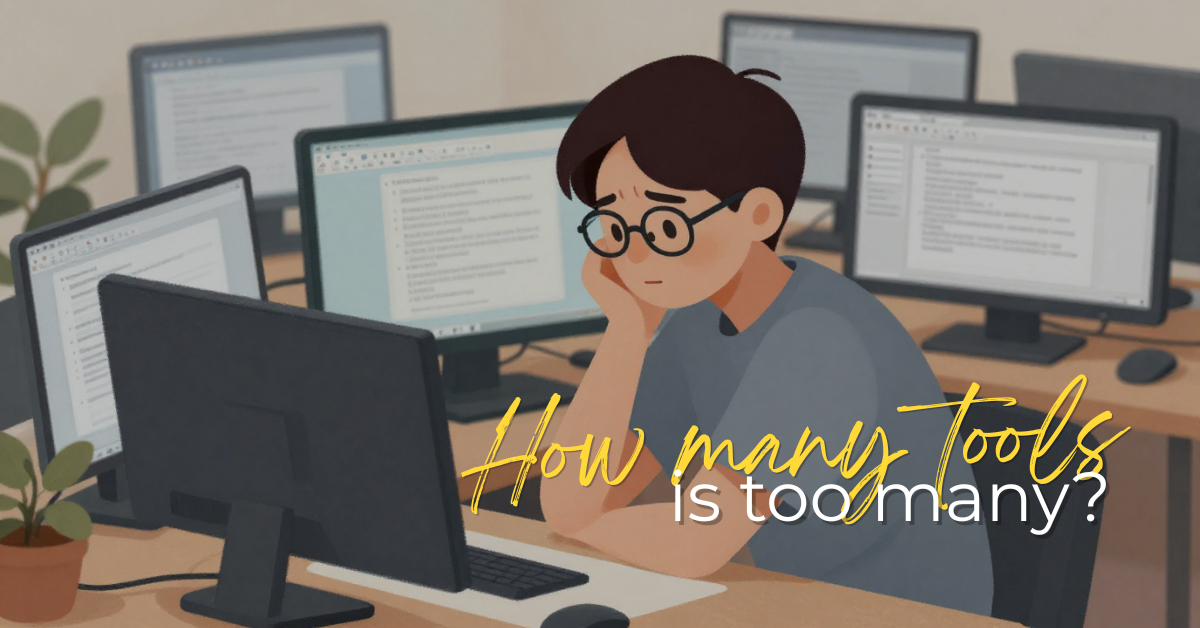
How many tools does your team actually need to do their job?
Not how many you’ve purchased, nor how many are “available.” How many are actively used without confusion, overlap, or workarounds?
Because in most businesses, the problem isn’t a lack of technology, but accumulation.
New tools get added to solve specific problems. Old ones rarely get removed. And over time, what started as an improvement turns into friction.
If you’re working with an IT MSP—or considering IT outsourcing—this is a useful place to pause: Is your technology stack making work easier… or just more layered?
What’s Actually Happening
Most duplicate tools appear gradually.
-
A new platform gets introduced for collaboration, but the old one stays “just in case.”
-
A department adopts its own solution because it moves faster than internal processes.
-
A feature exists in one tool, but another tool is purchased to solve the same problem more directly.
Individually, each decision makes sense. Collectively, they create:
- Confusion about where work happens
- Inconsistent processes across teams
- Higher costs than expected
- Slower onboarding and training
And most importantly: More decisions per task than necessary. That’s where friction lives.
Where Businesses Get It Wrong
The assumption is that more tools equal more capability. But capability without clarity rarely improves outcomes.
When teams operate across overlapping systems:
- Files live in multiple places
- Communication gets fragmented
- Reporting becomes unreliable
- Security gaps increase
And the hidden cost isn’t just financial. It’s cognitive.
Every extra tool requires your team to stop and think:
- Where should this go?
- Which system should I use?
- Is this the latest version?
Those micro-decisions compound throughout the day.
What Better Looks Like
Reducing duplicate stacks doesn't require you to cut tools aggressively.
It’s about designing a system where each tool has a clear purpose, and nothing competes for the same role.
That shift changes how work feels:
- Fewer decisions
- Clear ownership of systems
- Faster execution
- More consistent outputs
And it creates something most businesses don’t realize they’re missing: Operational flow.
What a Strong IT MSP Does Differently
This is where the difference between reactive support and strategic IT outsourcing becomes visible.
A strong IT MSP doesn’t just manage tools. They rationalize them.
That includes:
Stack visibility: Understanding what’s actually in use across the business—not just what’s licensed.
Redundancy identification: Spotting overlap between platforms (communication, storage, project management, security tools).
Intentional consolidation: Recommending where to standardize without disrupting operations.
Change management: Helping teams transition smoothly so adoption actually happens.
Ongoing alignment: Revisiting the stack as the business evolves, so complexity doesn’t rebuild.
Because without that last step, the duplicate stack always comes back.
A Practical Way to Evaluate Your Stack
You don’t need a full audit to start seeing the pattern. Ask a few simple questions:
- How many tools do we use for communication internally?
- Where do official documents live—and does everyone agree?
- Are there tools we’re paying for that only one team uses?
- Do new hires get confused about where to find or do things?
And one that tends to reveal the most: If we removed one of our core tools tomorrow, would people know what to replace it with?
If the answer is unclear, there’s likely overlap.
The Hidden Cost of “We’ll Deal With It Later”
A duplicate stack rarely feels urgent. That is because everything still works, but over time, it creates:
- Slower execution
- Higher support needs
- Increased security exposure
- Lower ROI on technology investments
And eventually, businesses reach a point where simplifying feels harder than maintaining the current state.
That’s usually when they start looking for outside support.
How This Connects to Choosing the Right IT MSP
Most businesses evaluate an IT MSP based on responsiveness and support quality.
But when it comes to long-term efficiency, a more important question is: Is your IT MSP reducing complexity, or quietly maintaining it?
Because maintaining everything as-is is easier in the short term.
Optimizing it requires:
- Context
- Business understanding
- Willingness to challenge existing setups
A strong IT outsourcing partner doesn’t just keep systems running.
They make sure those systems make sense.
Take advantage of Spring Cleaning
Spring cleaning is a useful metaphor... this is about removing friction.
Because the tools your team uses every day shape how decisions are made, how quickly work moves, and how consistent your outcomes are.
And over time, that defines how your business performs.
If you’re not sure whether your current stack is helping or slowing things down, this is exactly the kind of clarity we help provide.
Schedule a FREE IT Compass Scan with KairosIT. In 15 minutes, we’ll help you:
- Identify areas of unnecessary complexity
- Spot overlapping tools and hidden inefficiencies
- Outline practical ways to streamline your environment
No overhaul. No pressure. Just a clearer view of what’s working—and what isn’t.
.png?width=1200&length=1200&name=LP%20Banner%20EOY%202025%20(5).png)