



CMMC for construction companies: what applies and where to start

If your construction company works on Department of Defense (DoD) projects, your contract may carry Cybersecurity Maturity Model Certification (CMMC) requirements. This guide shows you how to find the requirement your contract lists, which project information triggers it, and what to do first. It also covers where Microsoft 365, Defender, Intune, Azure Virtual Desktop, and GCC High may fit.
Key takeaways
- CMMC is a way for the DoD to check how contractors protect federal project information.
- Your contract sets the required level, based on the information your company receives, stores, or shares.
- Level 1 covers Federal Contract Information (FCI). Level 2 covers Controlled Unclassified Information (CUI).
- Primes and subcontractors can have different levels on the same project.
- The DoD suspended Phase 2 in July 2026. Phase 1 self-assessments remain in place.
- Start by reading your contract clauses and mapping where project files go.
Does CMMC apply to your construction company?
It can, if you work under a DoD contract that includes CMMC requirements. The rule reaches prime general contractors and lower-tier trades, including electrical, mechanical, plumbing, engineering, and design-build firms. Small businesses are not automatically exempt.
Your level comes from the contract and the information you handle. The project location does not set it. A firm that receives sensitive technical plans may carry a stronger requirement than a firm that receives only routine schedules.
Start with the solicitation or subcontract, then ask these questions:
- Do you handle nonpublic contract information? Check whether Level 1 applies.
- Do you receive a designated CUI? Check whether Level 2 applies.
- Do you only see publicly released information? Check whether any CMMC clause applies.
CMMC Level 1 and Level 2 at a glance
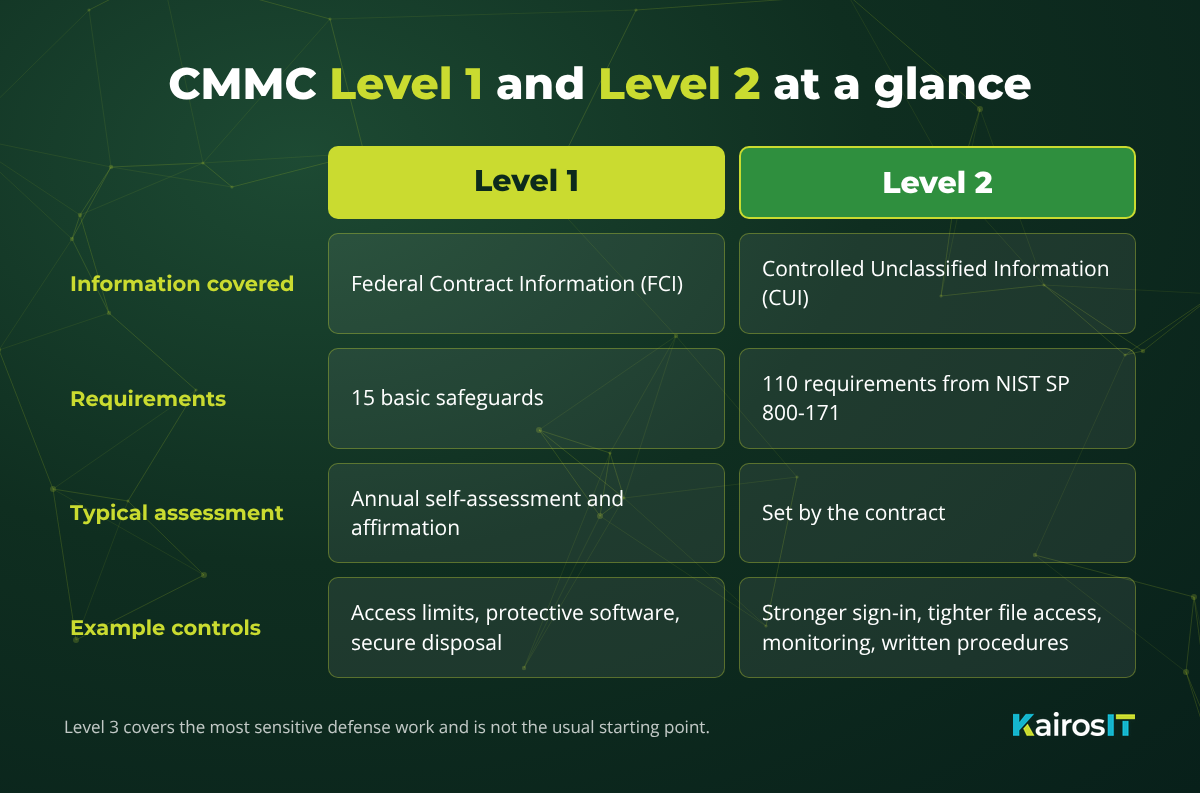
This table compares the two levels:
|
Level 1 |
Level 2 |
|
|
Information covered |
FCI |
CUI |
|
Requirements |
15 basic safeguards |
110 requirements from NIST SP 800-171 |
|
Typical assessment |
Annual self-assessment and affirmation |
Set by the contract |
|
Examples of controls |
Access limits, protective software, secure disposal |
Stronger sign-in, tighter file access, monitoring, written procedures |
Level 3 covers the most sensitive defense work. It is not the usual starting point for a construction company.
Which construction information needs protection?
FCI can include a nonpublic schedule, a contract deliverable, or project correspondence. CUI is information the government designates for added safeguards. On a defense project, that could include drawings that show critical infrastructure, secure areas, or security systems.
A drawing does not become CUI because it shows a military facility. If a package looks sensitive and its status is unclear, ask the prime contractor or contracting officer before you share it.
What primes and subcontractors each need to do 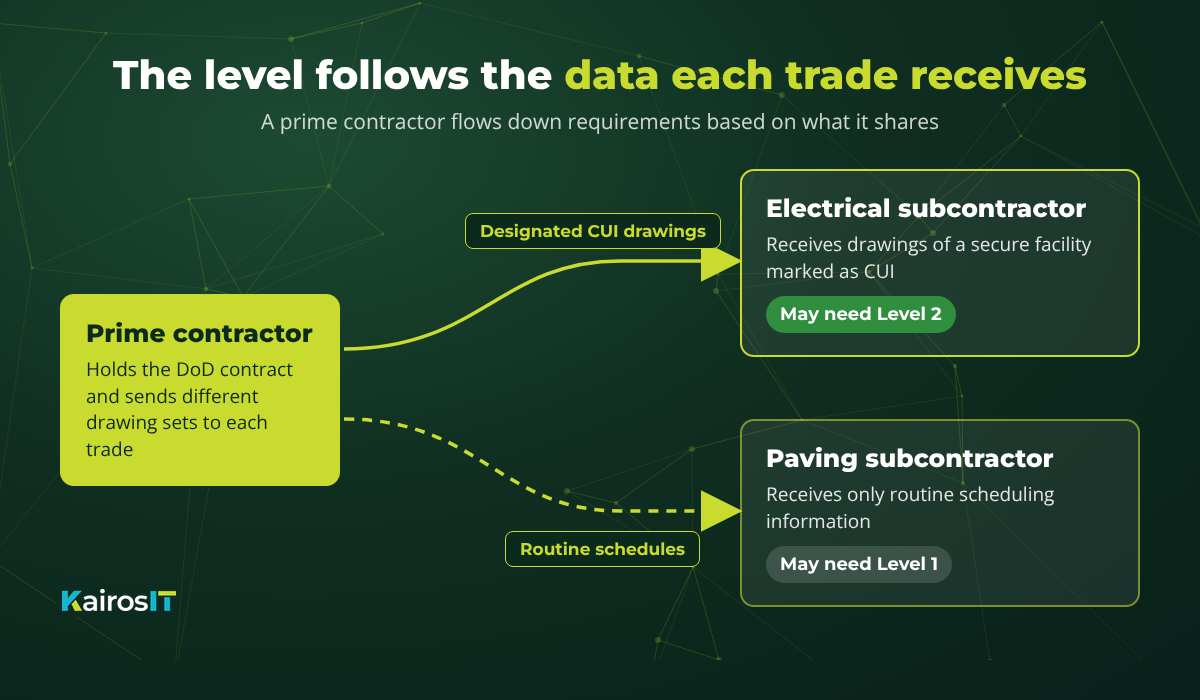
A prime contractor passes applicable requirements down to subcontractors whose work involves covered information. The level should match the data each trade receives.
An electrical subcontractor that receives designated CUI drawings of a secure facility may need Level 2. A paving subcontractor that receives only routine scheduling information may need Level 1. A subcontractor can't rely on the prime's assessment for its own systems.
General contractors can limit exposure by sending each trade only the drawings and files it needs.
Where CMMC stands in 2026
CMMC requirements began entering DoD solicitations in November 2025. On July 13, 2026, the Department of War suspended the Phase 2 requirements and said all Phase 1 self-assessment requirements remain in place. Phase 2 had been scheduled for November 10, 2026.
You still have cybersecurity duties under your contract clauses, including DFARS 252.204-7012. Check the DoD page and your solicitation before each bid, because the program is under review.
Where to start: six steps
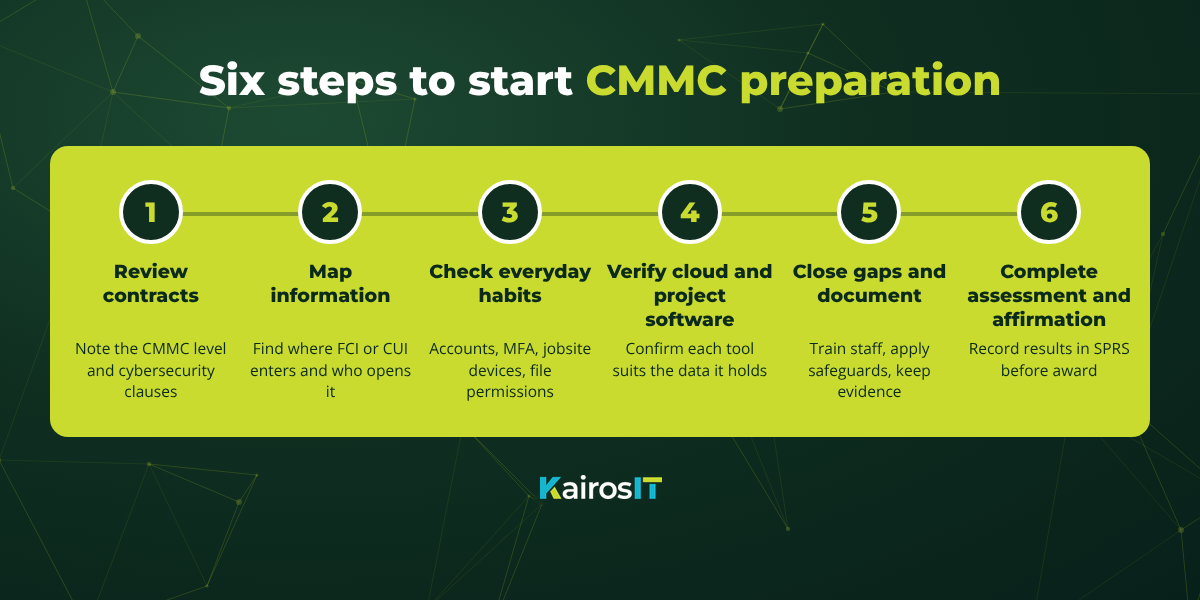
- Review your current and upcoming contracts. Note the stated CMMC level and cybersecurity clauses.
- Map the information you handle. Find where FCI or CUI enters your business, who opens it, and which subcontractors receive it.
- Check everyday habits. Review staff accounts, multifactor authentication (MFA), shared jobsite devices, project email, and file permissions.
- Verify your cloud and project software. A standard subscription is not proof that a tool suits CUI.
- Close gaps and document what works. Train the staff involved, apply the safeguards, and keep evidence.
- Complete the required assessment and affirmation. Record accurate results in the Supplier Performance Risk System (SPRS), where it applies, before award.
Time and cost vary with how much sensitive data you hold and which level applies. Our guide to the NIST Cybersecurity Framework 2.0 for SMBs can help you organize this work.
How Microsoft tools fit into a CMMC plan
Construction companies often ask whether the tools they already use can support the work. The answer depends on your contract, your license types, and how each tool is set up. Treat the sections below as questions to take to your assessment.
Microsoft 365 and Defender
Many firms use Microsoft 365 for email, files, and Teams. The questions are who can sign in, where files are shared, and which settings are on. Defender is Microsoft's security tooling for devices and email, and its settings matter as much as the license. Our post on 10 ways to harden Microsoft 365 lists the settings to review.
Intune and jobsite devices
Intune manages company laptops, tablets, and phones. For a construction firm, it can show which devices are enrolled and which accounts they use. That helps when crews share devices across sites. Pair it with the identity controls in our post on identity as the new security perimeter.
Azure Virtual Desktop
Some contractors keep sensitive files inside a controlled virtual desktop so the files stay off personal and jobsite devices. That can narrow the number of systems in scope. KairosIT offers Azure Virtual Desktop, and whether it fits your plan depends on the design and your assessment scope.
GCC High
GCC High is Microsoft's government cloud for contractors that handle CUI. The DFARS clause, as Microsoft's compliance page states it, requires cloud providers to meet security requirements equivalent to the FedRAMP Moderate baseline. Whether your company needs GCC High depends on your contract and the CUI you hold. Ask your prime or contracting officer before you buy.
What to bring to a readiness review
- The CMMC and DFARS clauses from each active contract.
- A list of who receives drawings and project files, including subcontractors.
- A count of users and devices, including shared jobsite devices.
- Your Microsoft 365 license types and the project tools your team uses.
- Notes on where project files are stored today.
Frequently asked questions
Who decides whether a drawing is CUI?
The government or the prime contractor designates it, usually through the contract or a marking. If a package isn't marked and you aren't sure, ask the prime or contracting officer before sharing it.
Can we keep using our current project software?
Possibly. The specific service and its settings need to fit the information you handle. A standard commercial subscription is not proof of CUI suitability.
Does Level 1 need a third-party assessment?
Level 1 uses an annual self-assessment and affirmation. Level 2 assessment type is set by the contract. The DoD suspended Phase 2 in July 2026, so check your solicitation for what it requires.
What happens if we don't meet a required level?
You can lose eligibility for an award that requires that level. Confirm your status and the contract terms before you pursue covered work.
What does your next defense bid require? Start with the KairosIT Compliance Readiness Assessment
Your CMMC requirement comes from your contract and your data. A review before you bid gives you time to close gaps before award.
The KairosIT Compliance Readiness Assessment is a structured evaluation of your security posture, backup integrity, and regulatory documentation gaps. You finish with a written findings report you can act on, whether or not you work with us. Bring your contract clauses, and we'll document what is in place today. KairosIT supports your compliance work and doesn't provide formal attestation or certification.